Primary Factors
Determine these critical requirements before selecting a process:
- Zinc vs. Zinc Alloy specifications
- Base substrate material
- Required corrosion protection (salt spray hours)
- Deposit thickness uniformity
Secondary Factors
Refine your choice based on operational constraints:
- Deposit appearance and ductility
- Make-up and ongoing operating costs
- Efficiency and pre-plate requirements
- Environmental and waste treatment restrictions
Topcoats & Sealers
Special passivate formulations (hexavalent or trivalent) are required to maximize white salt corrosion protection. Alloys like Zn/Ni and Zn/Co benefit significantly from proper sealing.
Table I — Attributes of Zinc Electroplating Processes
Scale: 5 = Excellent | 3 = Good | 1 = Poor
| Attribute | Alkaline Zinc | Acid Zinc | ||||||
|---|---|---|---|---|---|---|---|---|
| CN (Cyanide) | NCN (Non-Cyanide) | CHLORIDE | SO4 | |||||
| LC | HC | LC | HC* | NAm | LAm | Am | ||
| Substrate¹ | 2 | 3 | 3 | 4 | 5 | 5 | 5 | 4 |
| Ecological Concerns² | 2 | 1 | 5 | 5 | 5 | 4 | 4 | 5 |
| Make-up Cost | 5 | 3 | 5 | 4+ | 3 | 4 | 4 | 3 |
| Operating Cost³ | 3 | 2 | 4 | 4+ | 3 | 3 | 3 | 3 |
| Pre-Plate⁴ | 5 | 5 | 2 | 3 | 3 | 3 | 3 | 3 |
| Soln. Corrosivity | 4 | 4 | 4 | 4 | 3 | 2 | 2 | 1 |
| Soln. Conductivity | 2 | 3 | 2 | 3 | 4 | 4 | 4 | 3 |
| Soln. Rinsability | 2 | 2 | 4 | 3+ | 3 | 3 | 3 | 3 |
| Ease of Operation | 4 | 5 | 4 | 3 | 3 | 3 | 4 | 4 |
| Plating Speed | 2 | 3 | 2 | 4 | 5 | 5 | 5 | 5 |
| Throwing Power | 4 | 4 | 3 | 5 | 3 | 3 | 3 | 2 |
| Covering Power | 2 | 2 | 3 | 3 | 4 | 4 | 5 | 3 |
| Deposit Ductility | 4 | 5 | 4 | 4 | 3 | 3 | 3 | 3 |
| Deposit Adhesion | 5 | 5 | 3 | 3 | 4 | 4 | 4 | 4 |
| Appearance | 3 | 3 | 3 | 4 | 5 | 5 | 5 | 2 |
| Chromate Receptivity | 5 | 5 | 4 | 5 | 4 | 4 | 4 | 4 |
| Corrosion Protection | 2 | 2 | 2 | 3 | 2 | 2 | 2 | 2 |
1) Ability to plate a wide variety of substrates. 2) Toxicity & waste-treatability. 3)
Direct bath operating cost. 4) Bath's ability to tolerate poor preparation.
*Sodium and potassium baths are available. The superscript (+ or -) indicates the effect of using a
potassium based bath over a sodium based bath.
Alkaline Cyanide & Non-Cyanide Processes
Alkaline Cyanide: The historical benchmark for covering power and deposit adhesion. Operating requirements are minimal, but toxicity and waste treatment costs have reduced its popularity.
Alkaline Non-Cyanide: Utilizes organic reaction products to eliminate heavy chelators. Offers superior deposit distribution without the chipping or star-dusting associated with older processes.
Utilizing a zinc generation tank simplifies the control of zinc concentration without complex auxiliary setups, making control of the zinc concentration easy and efficient.
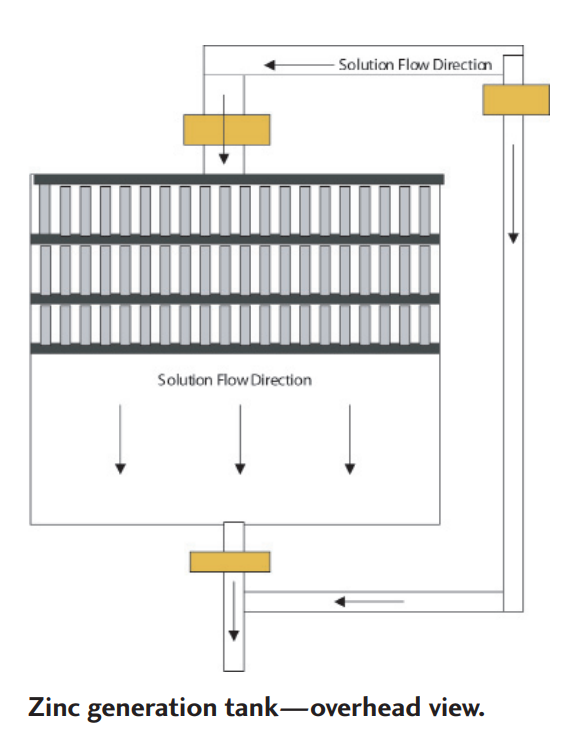
Fig 1. Zinc generation tank—overhead view
Table II — Common Chloride Zinc Bath Chemistries
Chloride processes offer superior brilliance (rivaling nickel-chrome), high plating efficiency (95-100%), and the ability to plate cast iron.
| Chloride Zinc Bath Type | All Potassium | Low Ammonium | All Ammonium |
|---|---|---|---|
| Zinc (oz/gal)/(g/L) | 3–5 / 22.5–37.5 | 2.5–4.5 / 18.7–33.7 | 2.0–4.5 / 15–33.7 |
| Ammonium Chloride (oz/gal)/(g/L) | -- | 4–8 / 30–60 | 18–22 / 135–165 |
| Potassium Chloride (oz/gal)/(g/L) | 25–30 / 187–225 | 16–20 / 120–150 | -- |
| Boric Acid (oz/gal)/(g/L) | 3–5 / 22.5–37.5 | -- | -- |
| Proprietary Additives | As recommended | As recommended | As recommended |
| pH | 4.5–5.2 | 5.5–6.0 | 5.5–6.0 |
| Temperature, °F (°C) | 70–130 (21–55) | 80–140 (27–60) | 85–140 (29–60) |
| Agitation | Recommended for rack | Recommended for rack | Recommended for rack |
| Filtration | Yes | Yes | Yes |
| Type of Operation | Rack or barrel | Rack or barrel | Rack or barrel |
| Voltage (V) | 2–13 | 2–12 | 2–12 |
| Current Density, asf | 1–25 | 1–30 | 1–35 |
| Plating Efficiency, % | 95–100 | 95–100 | 95–100 |
| Plate Distribution | Fair | Fair | Fair |
Table III — Zinc Alloy Processes
Driven by automotive and electronics industries, zinc alloys provide elevated temperature resilience, hardness, and extreme salt spray protection.
| Alloy Type | Alloy Composition | Plating Processes |
|---|---|---|
| Zn/Ni | 5–10% nickel (low) | Alkaline non-cyanide or acid chloride |
| Zn/Ni | 10–16% nickel (high) | Alkaline non-cyanide or acid chloride |
| Zn/Co | 0.2–1.2% | Alkaline non-cyanide or acid chloride |
| Zn/Fe | 0.2–1.2% | Alkaline non-cyanide |
| Sn/Zn | 70–80% tin | Neutral non-cyanide |
Why Choose GE Process?
Our 28+ years of expertise in metal finishing means we don't just run parts—we engineer solutions. We help you choose the exact zinc electroplating or alloy process required for your operational environment, whether it's maximizing salt-spray protection, meeting tight automotive tolerances, or optimizing for rapid turnaround.
- Precision Control: Automated bath monitoring ensures zero-defect coverage on every part.
- Tailored Topcoats: We match the exact passivate sealers to your corrosion requirements.
- TAFE Approved: Certified, industry-leading quality assurance you can trust.